
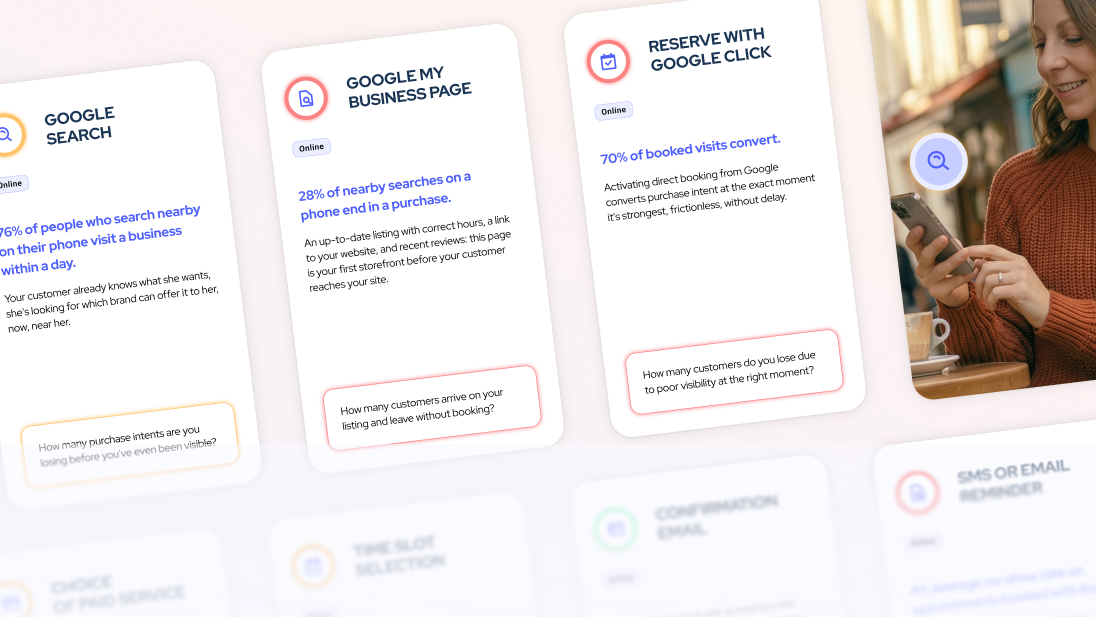

A retail customer journey map lays out every touchpoint between a customer's first search and their next visit, and shows where friction makes them leave. We've drawn five of them, for luxury, beauty, department stores, jewellery and pet care, on the same 13-step skeleton. The skeleton holds from one store to the next, but what leaks out of it changes: purchase intent in luxury, the customer herself in beauty, event visitors in department stores, the client after the sale in jewellery, and trust in pet care.
Most retail journey maps borrow the marketing funnel: awareness, consideration, purchase, retention, advocacy. That model was built for e-commerce, where the purchase is a click.
In physical retail, the steps that decide the sale sit around the visit itself. Booking a slot. Getting a reminder that's worth reading. Being recognized at the door. Being followed up after. A funnel folds all of that into one word, "purchase", which is why so many maps stop being useful the moment the customer walks in.
A journey map that includes the store does three things a funnel can't. It lists every touchpoint, online and in store, in the order the customer meets it. It grades the friction at each one (on our maps: extreme and costly, real tension, or opportunity to strengthen). And it attaches a question a retail leader can answer about their own stores.
One distinction matters here. A pain point is what the customer feels. A friction point is where the store loses them, and it has an owner. Maps built on pain points describe the customer; maps built on friction points tell a team what to fix.
Each of our five maps runs on four phases. The touchpoints change names by vertical (a store locator in luxury, an event agenda page in department stores, a client account in jewellery), but the count stays at 13 and the order stays the same.
Booking is the phase generic retail maps skip. It's also where a visit is won or lost before anyone in the store knows it existed, which is why no-show rates belong on a journey map and not only in an operations report.
Almost four in five luxury purchases still happen offline: online accounted for 21% of the luxury market in 2025, according to Bain & Company and Altagamma. Discovery often starts on Instagram; the sale still happens in the boutique. The luxury map is about the distance between the two.
The friction sits early. A client spots a piece in a story, lands on the brand site, opens the store locator, and finds an address and opening hours. No way to book a private consultation, no view of which services the boutique offers. Intent dies a few clicks away from a store that would have converted it.
The question the map asks: how many of your store locators have no link to an in-store experience?
Download the luxury journey map
In beauty, the journey usually starts on Google, not on the brand site. According to Think with Google, 76% of people who search on their smartphone for something nearby visit a related business within a day. Our beauty map opens on Google itself, with the Business Profile and Reserve with Google, before the customer ever reaches the brand's service page. At each of those first steps, the customer decides to continue or look elsewhere.
Then comes booking (service, slot, confirmation, reminder), where intent becomes a confirmed visit or a no-show. Then the consultation, where the digital promise meets an associate who may or may not know what was booked.
Beauty loses the customer herself, at any of the 13 steps, and rarely notices. A walk-away doesn't show up in any report. It just doesn't come back.
Download the beauty journey map
91% of US consumers say they have more positive feelings about a brand after attending one of its events or experiences (EventTrack 2018). Department stores run dozens of them: beauty masterclasses, launches, private evenings. Our map follows one visitor from the announcement email to the checkout.
The costliest friction lands on the day itself. A registered visitor arrives, finds no dedicated welcome point, and ends up in the same line as the walk-ins. The registration served no purpose, and the irritation starts before the experience does. After the workshop, nobody walks them to the floor where the products they just tried are sold.
Department stores lose visitors they had already convinced. The question: does the wait cancel what you invested to create the moment?
Download the department store journey map
In jewellery, the sale is where the relationship starts. Repairs, resizing, servicing, warranty claims: clients come back, often, with a piece they care about. That's why our jewellery map is an after-sales map.
The stakes went up fast. About 20 million consumers left the luxury market in 2025 alone, bringing the active client base to around 330 million, down from 400 million in 2022 (Bain & Company and Altagamma). Every client who comes back for a repair is one the house can't afford to lose.
The frictions are unglamorous. The after-sales booking is a phone number or a generic email address. The client account shows an order history, not the piece's service record. At drop-off, the jeweller's diagnostic is explained out loud and never written down, so the next visit starts from zero.
Jewellery loses the client after the sale, at the exact moment it had the best chance to keep them. The question: does your brand remember every piece, or start from scratch each time?
Download the jewellery journey map
97% of US pet owners say their pets are part of their family (Pew Research Center). A pet care customer is choosing who to trust with that family member, for the 10 to 13 years a medium-sized dog lives, up to 15 for small breeds.
Services are where that trust gets built, and where the growth is. In Petco's third quarter of 2025, services revenue rose about 3% while product sales fell about 4% ($254.8M against $248.2M, and $1.21B against $1.26B a year earlier).
The sharpest friction sits in the store. On a grooming Saturday, the line decides the rest: a stressed animal kept standing, an advisor who doesn't know the breed, the allergy or the last visit. Then the checkout. The customer leaves with the food, no next date, nothing to bring them back.
Pet care loses trust, and trust lost in year one costs the years that follow. The question: how many of your advisors know what's coming before the customer walks in?
Download the pet care journey map
Put the five maps side by side and the costliest frictions don't sit inside a channel. They sit between channels: a store locator with no path to a booking, a calendar out of sync with the store, an advisor who never sees what the customer shared online, a checkout that ends the relationship instead of booking the next visit.
Which is why we think most journey maps get drawn by the wrong team. The e-commerce team maps until the order confirmation. The store team maps from the door. Nobody owns the handoff, and the handoff is where every one of these five maps asks its hardest questions.
A journey map earns its keep when every red touchpoint has a name next to it. Not a department. A name.
Then revisit the map when something changes in the store, not on a calendar: a new booking flow, a new service, a new event format.
A retail customer journey map is a visual sequence of every touchpoint a customer meets, from first search to the visit after next, with the friction at each step graded and explained. In physical retail, it covers the booking, the in-store welcome and the post-visit, not only the online path to purchase.
Marketing models use awareness, consideration, purchase, retention and advocacy. For mapping store operations, we use four phases instead: digital discovery, appointment booking, in-store welcome and post-visit. They match the moments where a store team can actually act.
Enough to cover every moment the customer can leave, and few enough that each one gets an owner. Our five maps use 13 each. Past 15, maps tend to describe internal processes the customer never sees.
Appointments sit between digital discovery and the store visit: they turn online intent into a confirmed, prepared visit. We cover that role in detail in where appointments fit in the retail customer journey.
No. A journey map zooms in on one scenario, touchpoint by touchpoint. The customer lifecycle zooms out on the whole relationship, across many journeys.
Every map in this series ends at the checkout. In the stores that keep their customers, that's where the next visit gets booked.
Download the map for your vertical: luxury, beauty, department stores, jewellery or pet care.
More To Explore
5 Retail Customer Journey Map Examples, and What Each Vertical Loses
Where Appointments Fit in the Retail Customer Journey
How Retail Appointments Improve Customer Experience in 2026