
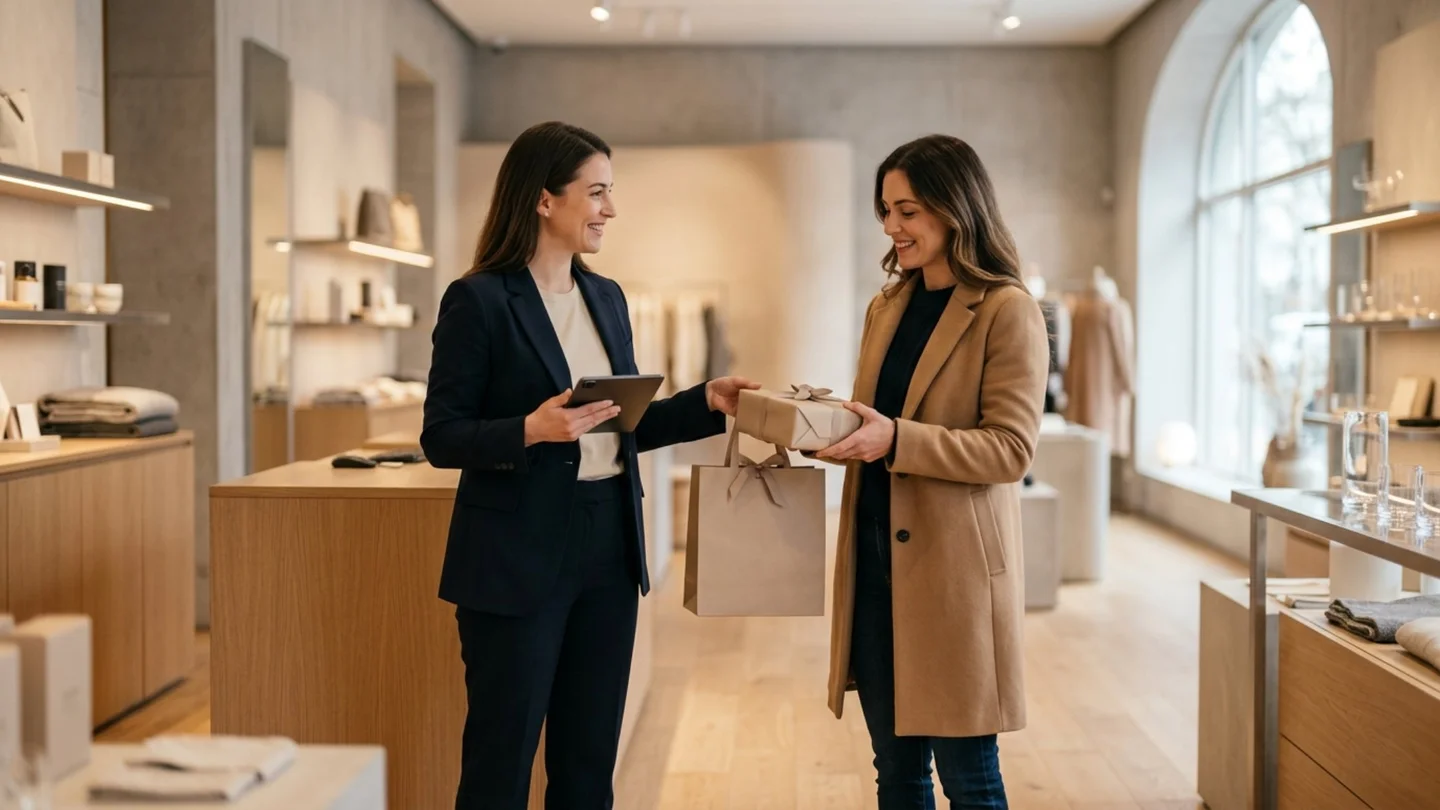

BOPIS is reshaping how retail networks connect digital demand with in-store revenue. Shoppers research products online, compare options from their couch, then expect to walk in and pick up their purchase the same day. That shopping behavior isn't a trend, it's the baseline expectation every retailer with both digital and physical channels has to meet.
BOPIS turns every store into a local distribution point, a cross-sell surface, and an experience touchpoint, all from a single digital transaction. Here's how the model works, who's adopting it, what shoppers and retailers gain from it, and the technology infrastructure store networks need to operate it at scale.
BOPIS stands for Buy Online, Pick Up In-Store. It's an order fulfillment option that connects a retailer's e-commerce channel to its physical storefronts, letting customers place an order online and collect it at a nearby store location instead of waiting for home delivery.
The model sits within a broader family of omnichannel fulfillment options.
All of these fall under the click-and-collect umbrella, with BOPIS as the most widely adopted format.
BOPIS isn't a pandemic workaround that became permanent by accident. The model existed in grocery and big-box retail years before 2020. What changed is the speed of adoption across every vertical, from luxury and beauty to fashion and electronics.
Retailers that treated BOPIS as a temporary fix are now rebuilding it as a permanent fulfillment channel because the shopping behavior behind it, researching online and buying in-store, predates the pandemic and will outlast it.
BOPIS in retail follows a 3-stage process:
Each stage involves real-time inventory checks, automated notifications, and a ready-for-pickup confirmation that keeps both the shopper and the store synchronized.
The process starts on the retailer's digital storefront: e-commerce site, mobile app, or marketplace listing. A customer browses the catalog, adds items to the cart, and selects BOPIS as the fulfillment option at checkout. The system checks real-time stock levels across store locations and confirms whether the selected item is available at the customer's preferred pickup point.
If the item is out of stock at the closest location, the system offers alternatives with available inventory. The customer selects a store and a pickup window that fits their schedule, getting the same shopping convenience as home delivery with the added control of choosing exactly when and where to collect.
Once the order is confirmed, store staff locates the item from in-store inventory, a connected warehouse, or another location in the network. The product is pulled, inspected, and set aside in a dedicated staging area. Automated notifications track every stage of this process through the retailer's digital communication stack: order confirmed, item ready for pickup, pickup reminder, and post-pickup follow-up.
Speed of readiness is the operational bar that separates functional BOPIS from failed BOPIS. 49% of retailers identify order readiness speed as their top BOPIS challenge, so same-day or 1-hour pickup windows have become the management standard. Without dedicated fulfillment staff, pulling BOPIS orders competes directly with in-store service for walk-in customers. That tradeoff between fulfillment time and sales floor coverage is the problem every store network has to solve before scaling BOPIS beyond a single location.
Three pickup formats serve different operational and customer needs.
In-store counter pickup is the most common: the customer walks into the store, approaches a dedicated desk near the entrance, and staff verifies the order before handing it off. This format works best for stores with high foot traffic and enough floor space to host a visible pickup zone without disrupting the main shopping area.
Curbside pickup (BOPAC) removes the need to enter the store entirely. The customer parks in a designated spot, notifies the store via app or SMS, and staff delivers the order to the vehicle. Retailers with an established curbside pickup management workflow handle this seamlessly, but the model requires dedicated parking, mobile notification systems, and staff assigned to outdoor delivery.
Automated lockers offer a third way: the customer receives a code after the order is packed, scans it at a self-service locker at the store location, and retrieves the package on their own schedule. No staff interaction, no wait time.
Each format solves a different customer expectation, and multi-location stores offering BOPIS at scale typically deploy more than one.
BOPIS in retail isn't a niche fulfillment experiment. It's a multi-billion-dollar revenue channel with measurable momentum across the U.S. market, and its growth rate offers a clear signal to retailers with both digital and physical sales channels.
The U.S. BOPIS market reached an estimated $129.36 billion in 2024. Projections point to $509.4 billion by 2033 at a compound annual growth rate above 16%. That growth trajectory reflects a structural shift in how American consumers approach online shopping and in-store fulfillment across digital and physical retail channels.
Click-and-collect sales now represent a growing share of total e-commerce revenue, and BOPIS is outpacing standard e-commerce growth year over year. The majority of major U.S. retailers already offer a BOPIS option, which means the competitive baseline has moved: new entrants aren't introducing BOPIS as a differentiator, they're adding it to avoid falling behind networks that already have it in place.
BOPIS adoption in the U.S. spans tens of millions of regular users, with roughly a third of American consumers using the model at least occasionally. Repeat use is high: the majority of BOPIS shoppers have completed multiple pickups, signaling that the experience converts first-time users into habitual buyers.
Younger demographics drive the strongest adoption. Millennials and Gen Z use BOPIS at higher rates than older cohorts, treating online-to-store shopping as a default fulfillment path rather than a fallback.
BOPIS adoption isn't driven by a single factor. Shoppers want control over cost, timing, and product verification, and BOPIS delivers on all 3. The need to eliminate shipping fees, the convenience of same-day pickup, and the ability to inspect items before leaving the store explain why consumers increasingly prefer BOPIS over standard home delivery.
Shipping costs are the primary reason consumers switch from home delivery to BOPIS. A significant portion of online carts get abandoned the moment unexpected fees appear at checkout, and BOPIS eliminates that friction entirely. The purchase completes without any shipping charge because the customer handles the last mile.
Same-day access is the second driver. Home delivery typically requires a 2-5 day wait, sometimes longer. BOPIS offers a pickup window measured in hours, not days. For time-sensitive purchases, like a replacement appliance part or a last-minute gift, that speed difference determines whether the sale happens at all.
BOPIS gives shoppers a way to shop on their own terms. They browse and compare products at home, make a decision without sales floor pressure, and schedule pickup around their existing routine. That convenience is what separates BOPIS from both impulse in-store shopping and passive home delivery.
Product verification adds another layer to the experience. Customers who use BOPIS can inspect the item at pickup, confirm the size, color, or condition matches expectations, and resolve any issues face-to-face with store staff. That option isn't available with standard delivery, where returns require shipping the item back and waiting for a replacement.
85% of BOPIS shoppers make additional in-store purchases during pickup. That number reframes BOPIS from a logistics convenience into a conversion engine. Every pickup visit is a guaranteed store entry with a customer who already has a product in hand and a receipt in their inbox, so the psychological barrier to spending more is lower than it would be for a cold walk-in.
The cross-sell opportunity is built into the model. The customer walks past displays, sees promotions, and interacts with sales associates while collecting their order.
Last-mile delivery is the most expensive segment of the retail supply chain, often accounting for over half of total shipping costs. BOPIS removes that expense entirely. The customer drives to the store, collects the order, and handles the final leg of the delivery process themselves, without any carrier fees, packaging costs, or return-shipping losses from transit damage.
The cost savings compound when BOPIS orders piggyback on existing store replenishment shipments. Instead of routing individual packages through a fulfillment center to a doorstep, the retailer consolidates inventory at the store level and lets BOPIS offer same-day pickup from stock already on-site.
BOPIS forces real-time inventory accuracy across every store location in the network. When a customer places an order for pickup at a specific store, the system has to confirm that the item is in stock and available at that exact location. Delayed or siloed inventory data means the customer shows up to an empty shelf, and that single failure destroys trust in the BOPIS channel.
The operational discipline required to run reliable BOPIS fulfillment improves stock visibility network-wide. Inventory management systems update continuously across stores, reducing out-of-stock incidents and accelerating turnover.
A BOPIS pickup puts a customer inside the store who wouldn't have walked through the door otherwise. They enter with a confirmed order, collect it, and experience the full retail environment: merchandise displays, seasonal promotions, and associates available for consultation.
Retailers that treat the pickup moment as an entry point rather than an endpoint capture more value from every visit. Combining BOPIS traffic with structured in-store services, like personalized consultations, a dedicated queue management solution, and appointment booking strategies for retailers, turns a logistics transaction into an omnichannel service moment.
The BOPIS handoff is treated as a transaction endpoint. It should be treated as a conversion entry point. 85% of BOPIS shoppers make additional in-store purchases during pickup, which means the majority of BOPIS customers are already open to a second interaction. Most retail networks lose that opportunity because the pickup process ends at the counter handoff.
The retailers who capture incremental revenue from BOPIS traffic structure the pickup moment as a service surface, not a logistics surface. A BOPIS customer who is offered a scheduled consultation, a fitting, or a product demonstration at the moment of pickup converts at materially higher rates than a customer who simply collects and leaves. Booxi platform data across 6,000+ retail locations shows scheduled appointments convert at 70%, with average basket sizes 30% higher than walk-in transactions.
The operational requirement is a scheduling layer that can offer pickup-time consultations without disrupting the in-store flow. Enterprise retailers like Dior, Clarins, and Lacoste use Booxi alongside their BOPIS infrastructure precisely because the two solve different halves of the omnichannel equation: BOPIS routes online demand to the store, Booxi turns that store visit into a higher-value interaction.
BOPIS brings customers through the door. What happens after the pickup determines whether that visit generates a single transaction or a long-term relationship. Booxi's retail appointment scheduling software helps multi-location stores convert BOPIS traffic into higher-value experiences: scheduled consultations, personalized service appointments, and in-store events that turn one-time pickups into repeat visits. The result is more sales per visit, stronger customer retention, and a BOPIS program that offers measurable ROI across every store in the network.
BOPIS stands for Buy Online, Pick Up In-Store, the most widely used term for the fulfillment model that connects online orders to physical store pickups. Related acronyms include BOPAC (curbside), BORIS (returns), and ROPIS (reserve and pick up), all under the broader click-and-collect fulfillment category.
BOPIS is the full buy-online-pick-up-in-store model that includes in-store counter pickup, curbside delivery, and automated lockers. Curbside pickup (BOPAC) is one method within BOPIS where the customer stays in their vehicle while staff delivers the order, making it a subset rather than a separate fulfillment model.
Customers who enter a store to collect a BOPIS order are exposed to merchandise, displays, promotions, and sales associates they would miss with home delivery, and the majority of BOPIS shoppers act on that exposure by making additional purchases during pickup. Retailers that pair BOPIS with structured in-store services like scheduled consultations and pickup-time appointments convert even more of that traffic into incremental revenue. Booxi platform data shows scheduled appointments convert at 70% versus 20-30% for unstructured walk-ins, which is the measurable revenue gap of treating the pickup moment as a service surface.
BOPIS works across retail verticals including grocery, fashion, electronics, beauty, home goods, and luxury, with any retailer that has physical locations and an e-commerce presence able to implement it. Multi-location networks see the strongest return because more pickup points closer to each customer increase convenience and reduce the distance barrier.
Multi-location networks are the strongest candidates for BOPIS because inventory visibility across all stores lets the system route orders to the nearest stocked location, reducing fulfillment time and shipping costs. Centralized order management ensures consistent service standards across every pickup point, and scale amplifies every BOPIS advantage through more pickup options, broader geographic reach, and higher customer convenience.
BOPIS reduces return rates because customers inspect the product at pickup and resolve fit, color, or condition issues on the spot through instant exchanges handled by store staff. The retailer saves on reverse logistics costs and recovers the sale in the same visit.
BOPIS connects the digital and physical halves of a retail operation into a single fulfillment loop where online demand generates store traffic, store visits generate cross-sell revenue, and inventory data flows between both channels in real time. Retailers that integrate BOPIS into their omnichannel strategy use every store as both a sales floor and a distribution node.
The 3 primary BOPIS performance metrics are pickup completion rate (orders collected versus abandoned), time-to-ready (gap between order confirmation and pickup availability), and incremental in-store purchase rate. Together, these metrics give retailers a complete view of BOPIS channel health and the additional revenue generated during each pickup visit.
More To Explore

Physical Retail, at Its Best and at Its Worst

Retail Radar 2026: The Customer Journey Starts Before They Walk In

Creating More Human Retail Experiences in the Digital Age