


Most retailers frame build vs buy as a cost comparison. That's the wrong frame.
The right question is a capacity question: can your engineering team maintain a scheduling system forever, across every new store, every compliance update, every integration change, with the retail stack you run today and the one you'll run in three years? Because that's what build means for a multi-location retailer. Not a sprint. A permanent commitment.
When an IT Director at a 30-store fashion retailer asks "should we build or buy our scheduling system," they're not really asking about software. They're asking whether their engineering team should own this problem indefinitely.
Any team with engineers can build a scheduling system. The question is whether those engineers should spend the next five years maintaining it.
"Build" for a retailer doesn't mean build once. It means build, then maintain every reminder cadence update, every new store configuration, every time zone edge case, every GDPR consent flow revision, every integration change when Salesforce updates its API. The initial development sprint is the smallest part of the total commitment. Most retailers who choose to build underestimate this by treating the sprint as the cost, when the sprint is just the entry fee.
The framing matters because it changes the comparison. The right comparison isn't "cost of building vs cost of buying." It's "total five-year cost of building and maintaining vs total five-year cost of a bought solution at projected scale."
The build path has real advantages: complete control over the product, no vendor dependency, customization that matches exact workflows. For a retailer whose scheduling requirements are genuinely proprietary and central to competitive differentiation, build can be the right answer.
It rarely is. Here's why.
A scheduling system with multi-store support, SSO, booking confirmation flows, reminder cadences, no-show handling, and basic integrations takes six to eighteen months to build, test, and deploy. That estimate assumes a focused engineering team, clear requirements, and no competing priorities.
A beauty chain scaling from 10 to 80 stores, or any retailer opening 15 new locations next quarter, can't wait eighteen months to have a live system. A bought solution deploys in weeks. The opportunity cost of the gap isn't theoretical: every week without structured appointment booking is a week of walk-in conversion rates instead of booked-visit conversion rates.
Custom software doesn't hold still. Every feature addition, every regulatory update, every new store configuration, every integration change is an engineering ticket. In a retail context, this compounds quickly.
A scheduling system for a 10-store network has one level of complexity. The same system for 50 stores has a different architecture, different reporting requirements, different routing logic, and different configuration needs per location. Scaling a custom build isn't extending the original system. It's often rebuilding it.
Industry practice across enterprise software programs consistently shows that ongoing maintenance absorbs the majority of total lifecycle cost in custom builds. The development budget that looks bounded in year one becomes an open-ended maintenance commitment by year three. Retailers who don't model this explicitly into their TCO comparison are comparing the wrong numbers.
GDPR and CCPA don't stand still either. Consent flow requirements, data residency rules, and audit trail obligations evolve. On a custom build, every regulatory update is an engineering ticket owned by the internal team. On a bought solution, it's the vendor's obligation.
The same logic applies to integrations. Connecting a custom scheduling system to Salesforce, Shopify, and Cegid is not a one-time project. Each integration requires maintenance as APIs evolve. For a 40-store luxury retailer whose advisors need CRM context before every appointment, a Salesforce sync that breaks on an API update isn't a minor inconvenience. It's an operational failure that takes an engineering sprint to resolve.
The engineers maintaining the scheduling system are not building the retail product. They're not working on the clienteling layer, the data infrastructure, the personalization engine, or whatever actually differentiates the business in market. Every sprint allocated to scheduling maintenance is a sprint not allocated to core product development.
For most multi-location retailers, appointment scheduling is important but not differentiating. The competitive edge is in the in-store experience, the product, the clienteling. Building and maintaining infrastructure that a purpose-built vendor has already solved is an opportunity cost the business often doesn't price explicitly.
Buying is faster, lower initial cost, and shifts compliance and integration maintenance to the vendor. For most multi-location retailers operating at 20 or more stores, the buy path is the right default. But buying the wrong tool creates a different set of problems.
The biggest risk in the buy path isn't vendor lock-in. It's buying an SMB scheduling tool for an enterprise retail problem.
Tools like Calendly or Acuity Scheduling are built for single-location simplicity. Fast to set up, easy to use, low cost. They solve a calendar management problem for a solo practitioner or a small team. They are not built to orchestrate customer-facing appointment booking across 30 stores, route clients to the right advisor by skills and availability, provide centralized reporting to an HQ team, or connect natively to a retail tech stack.
This is the operator distinction that most build vs buy comparisons miss: a generic calendar tool and a retail appointment scheduling platform are not the same thing. A calendar tool handles back-office time slots and staff availability. A retail appointment scheduling platform is a customer-facing conversion channel, with booking intent, advisor routing, CRM context, and operational reporting. A retailer who buys a generic calendar tool when they need a retail appointment scheduling platform has solved the wrong problem, at any price.
A retail appointment scheduling solution built for multi-location operations has a different architecture than a generic calendar tool, because the operational problem it solves is structurally different.
Every scheduling vendor lists integrations. The right question is not "do you integrate with Salesforce" but "how does the data flow, and at what latency."
A Zapier-mediated connection that syncs CRM data once nightly is not the same as a native write-back that updates the client record in real time before the appointment. For a beauty chain whose consultants review client history in the fifteen minutes before a session, those are two different operational realities. For a luxury retailer managing VIC relationships across 40 boutiques, data latency in the CRM layer is a service failure.
The integration architecture between a scheduling platform and the retail stack determines whether the tool functions as a conversion layer or as a calendar widget with an API key. Evaluating vendors on integration presence rather than integration depth is how retailers end up with the second one.
For a deeper look at what connecting appointment management to an existing retail ecosystem actually involves, adding appointment management to your tech ecosystem covers the integration considerations in practice.
Some scheduling platforms charge per store or per user. A price point that looks reasonable at 10 locations multiplies significantly at 50. A retailer scaling from 20 to 60 stores can see subscription costs triple without a proportional increase in value delivered.
The TCO of a bought solution must include projected subscription cost at 2x and 3x current store count, not just today's pricing. A vendor whose pricing model punishes growth is a vendor whose incentives don't align with the retailer's trajectory.
Five criteria resolve the build vs buy decision for most multi-location retailers. Each has a clear directional signal. Running through all five should produce an unambiguous answer in most cases.
1. Store count and growth trajectory. If the network is under five stores with no expansion planned and the workflow is genuinely proprietary, build can be justified. If the network is at 10 or more stores, expansion is planned, and the system needs to be live within 90 days, buy is the right direction. The scaling cost of a custom build compounds with every new location.
2. Engineering team capacity and core focus. If the engineering team has dedicated bandwidth beyond the core business roadmap and scheduling is a true competitive differentiator, build can make sense. If the team is at or near capacity on core product and no dedicated squad exists to own a scheduling system through its full lifecycle, buying removes a permanent maintenance obligation from the roadmap.
3. Retail stack integration requirements. If the retailer runs a fully custom stack with no standard APIs and a proprietary POS with no third-party connectors, build may be the only path. If the stack includes Salesforce, Shopify, Cegid, or any standard retail infrastructure, a purpose-built scheduling vendor likely has those integrations already. Building them from scratch is paying for solved problems.
4. Compliance and data residency requirements. If sovereign data requirements or classified environments rule out third-party vendors entirely, build is the only option. If the requirement is GDPR and CCPA compliance with EU data residency, a vendor that owns that compliance posture and maintains it through regulatory changes reduces the internal compliance overhead to vendor selection and contract terms rather than engineering sprints.
5. Five-year total cost of ownership. The TCO of building equals initial development cost, plus annual maintenance multiplied across five years, plus compliance overhead, plus integration build and maintenance, plus opportunity cost of engineering time diverted from core product. The TCO of buying equals annual subscription multiplied across five years at projected store count, plus implementation cost, plus any customization. Retailers who run both numbers explicitly, including projected scale in the buy scenario and realistic maintenance burden in the build scenario, find that the comparison shifts significantly from what the initial sprint cost alone suggests.
For retailers evaluating an enterprise-scale deployment across a growing store network, the five-year TCO comparison is where the decision usually resolves.
Most retailers who arrive at build vs buy are asking the question one level too late.
The foundational question isn't whether to build or buy. It's whether the requirement is a generic calendar tool or a retail appointment scheduling platform. A calendar tool handles back-office time slots, staff availability, and confirmation emails. What most multi-location retailers actually need is a retail appointment scheduling platform: appointment booking as a conversion channel, with centralized orchestration across stores, CRM integration, operational reporting, and the infrastructure to turn a booked visit into a measurable revenue event.
A retailer who answers that question first will find that the build vs buy decision largely resolves itself. No engineering team builds a multi-location retail appointment scheduling platform with native retail stack integrations, real-time CRM sync, and centralized reporting from scratch when purpose-built solutions exist. And no retailer running 30 stores buys a generic calendar tool and calls it an enterprise appointment scheduling solution.
The question worth asking is: what does the business actually need from this system in three years, at twice the current store count, with the compliance requirements that will apply then? That answer tends to make the build vs buy decision obvious.
See how Booxi powers appointment booking across multi-location retail networks at enterprise scale.
The real TCO of a custom build includes the initial development cost, annual maintenance across the system's lifecycle, compliance overhead as GDPR and CCPA requirements evolve, integration build and maintenance costs for each retail stack connection, and the opportunity cost of engineering time diverted from core product development. The initial sprint is typically the smallest component of the five-year total. Retailers who model only the build cost without modeling the maintenance commitment are comparing the wrong numbers.
A genuine case for build exists when the scheduling workflow is proprietary and central to competitive differentiation, when sovereign data requirements rule out third-party vendors, when a dedicated engineering team exists with capacity beyond the core product roadmap, and when no commercial solution meets the functional requirements. Most multi-location retailers at 20 or more stores don't satisfy all four conditions simultaneously. When any one is absent, the maintenance and scaling burden of a custom build typically outweighs the control benefits.
The primary risk is architectural mismatch: SMB scheduling tools are built for single-location calendar management, not multi-store appointment booking with centralized orchestration, CRM integration, and network-level reporting. Deploying a tool built for five locations across 30 stores doesn't create an enterprise scheduling system. It creates 30 independent calendar instances with no shared routing logic, no centralized data, and no visibility at the HQ level. The risk isn't vendor lock-in. It's buying the wrong category of product.
The right evaluation goes beyond the integrations page. For each claimed integration, the questions are: does data write back to the source of record in real time or in batch? What happens when the connected system's API changes? What are the rate limits at high booking volume across 50 or more locations simultaneously? A native integration that updates Salesforce before the appointment starts is operationally different from a Zapier connection that syncs nightly. For retail operations where advisors depend on CRM context to deliver a personalized session, that difference is the difference between a tool that works and one that creates manual workarounds.
A generic calendar tool handles back-office time slots, staff availability, and internal workflow. A retail appointment scheduling platform is a customer-facing conversion channel: the client reserves a visit with intent, the system routes to the right advisor, the CRM is updated before the session, and the outcome is tracked as a revenue event. A retailer who builds or buys a generic calendar tool when the actual requirement is a retail appointment scheduling platform has solved the wrong problem. Identifying which category you actually need is the right question to answer before the build vs buy comparison begins.
More To Explore

How to Choose Retail Appointment Scheduling Software in 7 Steps
Build vs Buy Appointment Scheduling Software: The Real Decision for Multi-Location Retailers
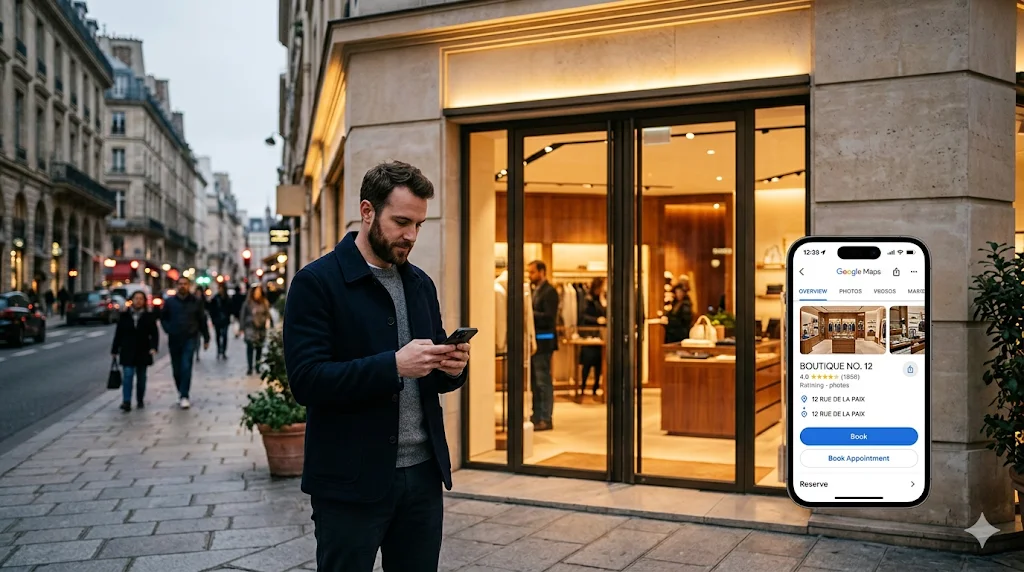
Reserve with Google for Retail: The Complete Guide