
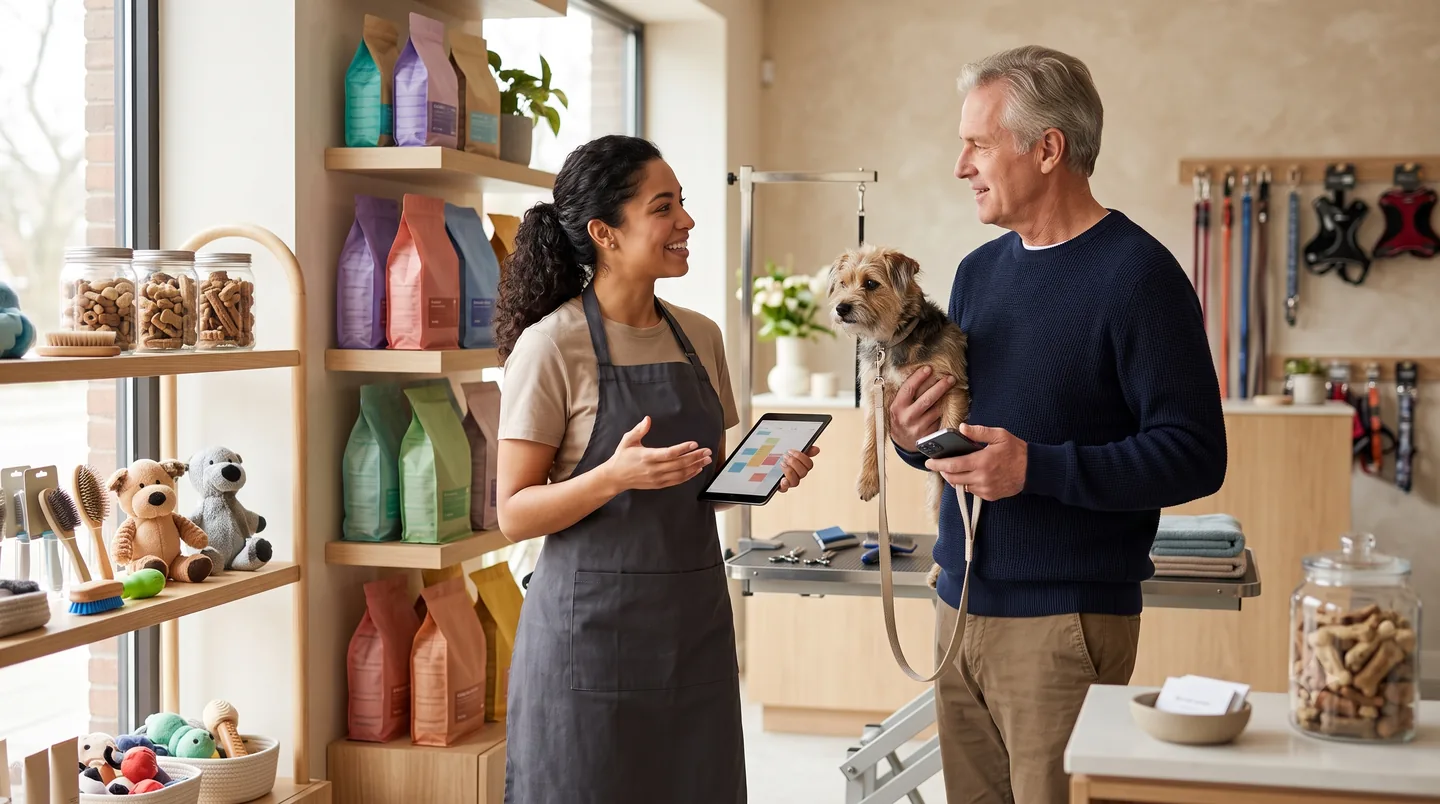

Google Business Profile bookings turn a store's listing into a direct booking channel: the customer finds a location, taps Book, and confirms a time slot without ever leaving Google. For a retail network running dozens or hundreds of locations, that single button changes what local search produces, moving the profile from an information page to a measurable source of in-store appointments. And the timing matters, because the traditional path from Google visibility to website conversion is eroding fast.
Organic CTR is in structural decline. 60% of Google searches now end without a single click to any website, the zero-click pattern Bain & Company measured in 2025. Where an AI Overview appears, organic CTR drops to 0.61%, versus 1.45% when none shows: Seer Interactive measured a 61% collapse over fifteen months (September 2025). And the top organic position, long treated as the finish line of SEO, delivered a 19% CTR in 2025, down from 28% a year earlier across GrowthSRC's study of 200,000 keywords.
Google is still where customers start. SE Ranking data shows AI platforms drive less than 1% of global internet traffic, while organic search still accounts for 48.5%. The audience never left. What eroded is the click that used to follow the impression, which is why ranking well and converting well have quietly become two different problems.
Local search is where that gap costs retailers the most. Americans run an estimated 800 million "near me" searches every month, and the intent behind them is immediate and physical: a beauty consultation this week, a same-day grooming slot, an eye exam before the weekend. When a customer with that intent lands on a listing with no way to act, the visibility was earned and the conversion was lost.
A Google Business Profile does one of two jobs: it informs, or it transacts.
A passive profile displays hours, photos, reviews, and a website link. The customer discovers the store, evaluates it, then leaves Google to figure out how to book: brand website, store locator, store page, booking form, confirmation. Four to six steps, each one a moment to get distracted or reconsider.
A transactional profile closes the loop inside the listing. The customer taps the booking button, picks a service and a time slot, and confirms. Three steps, completed before they ever leave the search results page.
One more distinction worth keeping sharp, because it shapes how networks measure this channel. The booking is the digital action: a customer commits to a time slot online. The appointment is the in-store event that follows: a prepared advisor, a planned service, a visit the store expected. A transactional profile generates bookings. The store turns them into appointments, and appointments into revenue.
There are two routes, and they aren't equivalent at network scale.
The first is a manual booking link. Any verified profile can add an appointment URL that sends the customer to an external booking page. It's quick to set up, one location at a time, and it still routes the customer away from Google to a page that has to convert on its own.
The second is the native Book button through Reserve with Google. The retailer's appointment scheduling software connects to Google as a booking provider, service and availability data feeds each listing, directly or through the network's listing management partner, and the customer completes the booking inside Google. This is the route built for multi-location networks: bookings flow into the scheduling infrastructure the stores already run on, location by location, without per-store manual setup.
Both routes need the foundation in place first. Each location needs a claimed, verified Google Business Profile with an address that matches Google Maps exactly. In our experience, the listing audit takes most networks longer than the technical activation itself.
For eligibility rules, feed architecture, and the full activation sequence, see our complete guide to Reserve with Google for retail.
Start with who the listing reaches. Birdeye's State of Google Business Profile 2026 report found that 86% of GBP impressions come from category searches, not branded ones. Customers type "facial near me" or "dog grooming open Saturday", and a store surfaces. The listing meets demand the brand's website never sees, which makes it an acquisition surface, not a brand asset.
Now look at what listings currently do with that demand. Across industries, Birdeye measures GBP engagement splitting into 47% website visits, 38% direction requests, and 15% phone calls. Every one of those calls to action defers the conversion: to a website session, to a store visit that may never happen, to a phone line at peak hours. A booking button is the only action on the listing that ends with a committed time slot.
The results are measurable. Early Reserve with Google activations with Booxi record a 30% average increase in conversion from the booking button alone. The activation itself runs through the network's listing management partner, whichever platform already manages its profiles. For a 30-location beauty network averaging 200 booked appointments per location each month, a lift in that range means hundreds of additional booked visits monthly, from a channel with no added media spend.
This is also where the omnichannel argument stops being abstract. The Google listing sits exactly between digital demand and store capacity, and a booked visit crosses that line carrying a name, a service, a time, and a reason. The store can staff for it, prepare for it, and measure what it produced: show-up rate, booking-to-visit conversion, transaction value against walk-ins.
A booking on its own proves interest. The revenue proof comes from what the store does with it, measured appointment by appointment. Networks that treat GBP bookings as a traffic metric capture a click. Networks that treat them as revenue events capture a P&L line.
Booking conversion doesn't run on the button alone. SOCi's State of Google Reviews research found that a one-star improvement in average rating drives a 44% increase in conversion actions on a listing (2022, still the reference study on the question). On a 40-location network, moving the average rating from 4.0 to 4.4 changes what every single listing yields.
And bookings feed the rating. A completed appointment is a review request earned. Reviews lift the rating, and the rating lifts conversion on the next customer's search. Networks that connect post-appointment feedback to their review flow get this loop running without asking store teams to do anything manually.
Profile hygiene carries the rest: accurate hours, current service menus, recent photos, consistent information across every location. Each fix raises the floor for the whole network, because local pack rankings and customer trust compound listing by listing.
Retailers spent a decade tuning their websites to convert Google traffic, and for most query types that investment still pays. For local, immediate, physical intent, the listing itself is now the storefront. The networks that win local search won't be the ones ranking highest. They'll be the ones a customer can book without ever leaving the page they searched on.
A booking link is a URL on the profile that redirects the customer to an external booking page, and any verified listing can add one manually. Reserve with Google places a native Book button on the listing and completes the booking inside Google, through a connected scheduling provider. For multi-location networks, the provider route scales through data feeds instead of per-store setup.
Booking links are open to any verified business. Reserve with Google is limited to eligible service categories: beauty, petcare, and eyewear are confirmed verticals in Booxi's activation experience, with luxury services under review by Google. Eligibility is assessed per service category, not per brand.
In our activation experience, conversion lift is visible within the first weeks once listings are live. The compounding effects, where appointments generate reviews that raise the rating that raises conversion, build over two to three months of operation.
No, but it needs a clean foundation: every location claimed, verified, and matching Google Maps exactly. For most networks the listing audit is the longest step. The technical activation itself is measured in days once the foundation is in place.
More To Explore
How Google Business Profile Bookings Convert Local Search Intent for Retail Networks
Best Retail Queue Management Software In 2026

Appointment Scheduling: What It Is and How It Works?