
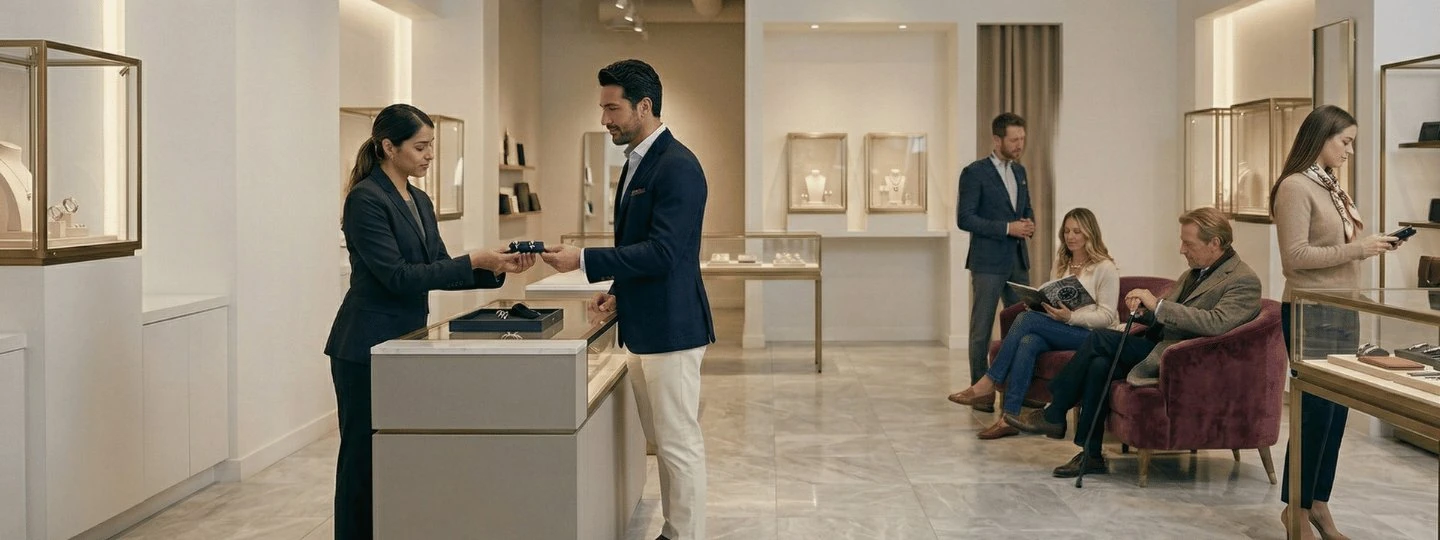

According to a 2023 global study on in-store experience, 80% of shoppers avoid entering a store if they see a visible queue, 40% will switch to a competitor if the line appears too long, and 73% abandon their purchase entirely when waits stretch beyond five minutes. Post-pandemic, tolerance keeps dropping, so every unmanaged minute in line now costs retailers lost revenue and eroded loyalty. Several proven strategies can reduce customer wait times in retail stores:
By combining them, the impact on conversion, basket size, and repeat visits compounds across every store in the network.
Long customer wait times in retail don't just frustrate shoppers. They directly erode revenue, loyalty, and the overall in-store experience. When customers walk into a store and face long queues and an unpredictable wait, their satisfaction drops before any interaction with staff even begins. The cost isn't limited to one lost transaction. It compounds across every visit, every store, and every peak period where operations fail to match customer expectations.
According to PwC (2023), 44% of consumers say they are less likely to return to a store that made them wait, and 73% consider the in-store experience to be the most important factor in their purchase decision.
What makes waiting particularly corrosive to loyalty is the psychological dimension: shoppers feel disrespected when forced to wait without certainty. It's not just the duration that drives dissatisfaction, it's the loss of control over personal time. A 5-minute wait with no visibility feels longer than a 10-minute wait with a clear estimate, which is why the perception of waiting often matters more than the actual time elapsed.
7 people in a queue is the tipping point: beyond that threshold, most shoppers won't even join a long line. During peak hours, unmanaged walk-in surges create bottlenecks at checkout lines and service counters that overwhelm staff capacity, block store flow, and push customers toward abandonment. After 9 minutes, shoppers are likely to leave empty-handed.
The root cause isn't foot traffic itself. It's demand unpredictability. Without real-time visibility into how many customers are in the store, which service points are saturated, and where staff are allocated, retailers operate blind during the hours that generate the most revenue. The result is a compounding operational failure: understaffed zones create longer waits, longer waits drive walk-outs, and walk-outs drain the exact revenue that peak hours are supposed to deliver. As Booxi's research on peak season retail shows, poor queue management can cut up to 20% of assisted sales, not due to product shortages, but to operational inefficiency.
Understanding the cost is the first step. The next is knowing which operational levers actually move the needle.
Reducing customer wait times in retail isn't a single-tool fix. It requires a system-level operational shift where multiple strategies work in parallel: queue management to handle walk-in flow directly, staffing optimization to allocate resources based on demand data, and appointment scheduling to redistribute traffic across the day. Each addresses a different layer of the problem, and confusing one for another leads to misallocated investment.
Queue management is the primary operational lever for directly reducing long customer wait times in retail stores. Instead of letting walk-in traffic accumulate unmanaged, a queue management system gives retailers real-time control over in-store flow:
The operational value extends beyond the customer-facing side. Queue data feeds real-time decisions on the floor: managers can reassign staff to high-traffic zones, speed up service by opening additional service points during surges, and identify bottlenecks before they escalate into walk-outs. Because every walk-in interaction is tracked, retailers gain visibility into service duration, peak patterns, and staff utilization, turning reactive management into a data-driven process.
Forward-thinking enterprise retailers understood this early: as documented in our queue management guide, Louis Vuitton deployed a digital queue management solution across 300+ boutiques as early as 2017 to manage high-traffic moments and maintain consistent VIP-level service at scale. Appointment scheduling spreads demand. Staffing data improves resource allocation. But reducing the actual wait when a customer is already in the store is where queue management owns the result.
Demand data transforms retail staffing from guesswork into precision allocation that directly reduces customer wait times. Most stores staff based on fixed schedules or gut instinct, which means they're consistently understaffed during peak surges and overstaffed during slow periods. Operational data closes that gap by giving managers the information they need to make informed decisions based on what's actually happening on the floor:
When staff allocation is driven by demand data instead of static schedules, the result is efficient resource deployment: the right number of people in the right zones at the right time. Managers can adjust staffing in real time during surges, allocate specialists based on appointment and service type, and forecast when additional staff will be needed before bottlenecks form. Tools like retail performance analytics turn this data into actionable dashboards that optimize store operations at scale.
Appointment scheduling spreads customer demand across the day, reducing peak-hour congestion while driving significantly higher conversion rates. Unlike queue management, which handles active wait times, appointment scheduling is a demand distribution and conversion lever. When customers make an appointment ahead of time, retailers can predict traffic, prepare staff with customer context, and deliver a personalized service experience before the shopper even walks through the door.
The conversion data makes the case. 57% of shoppers want to see and feel products before buying, and 68% seek expert advice on high-value purchases (EY 2024). When that in-store intent is channeled through a booking, the results are dramatic:
The key distinction is what appointments solve. They don't reduce wait times directly. They redistribute demand so peak hours aren't overwhelmed, staff can provide dedicated attention to each customer, and every booked visit becomes a high-intent business interaction. An appointment scheduling platform built for retail lets brands capture online intent, manage bookings across locations, and offer every customer a structured, efficient path from discovery to purchase.
Automated reminders and confirmation flows are one of the simplest strategies for keeping retail operations predictable and staff productive. When customers book an appointment, a confirmation email or SMS locks in the commitment. A reminder sent 24 to 48 hours before the visit reduces no-shows, which keeps the schedule intact and prevents staff from waiting idle for customers who never arrive.
The process works in both directions. If a customer can't make it, automated cancellation and rebooking flows let them reschedule digitally without calling the store or creating a gap that goes unfilled. For retailers managing hundreds of appointments across multiple locations, implementing this layer of automation means fewer scheduling gaps, less wasted capacity, more efficient use of staff time, and a tighter link between booked demand and actual foot traffic.
Giving customers multiple ways to enter the service flow, whether online or in-store, directly reduces physical congestion on the retail floor. When the only option is to walk in and wait, every customer competes for the same limited queue space during the same peak windows. Omnichannel entry points break that pattern by providing options:
Each available channel absorbs a portion of the traffic that might otherwise create a physical bottleneck. The experience improves for every customer type: those who plan ahead get a structured visit, and those who walk in get tools to manage their own wait. For retailers, more entry points means better demand visibility, tools to enhance the in-store experience, and a platform that captures every interaction, booked or spontaneous.
These strategies address the operational side. Knowing whether they're delivering results requires the right metrics.
The strategies above only matter if retailers can prove they're working. Measuring the impact of wait-time reduction requires tracking the right KPIs across operations, conversion, and customer satisfaction, then using that data to find new ways to improve over time.
Seven key metrics give retailers a clear picture of whether their wait-time reduction strategies are delivering results:
The real value of measurement isn't a single report. It's the compounding effect over time. Better data leads to smarter staffing decisions, which produce shorter waits, which build stronger customer loyalty, which drives higher revenue. Each cycle reinforces the next, and retailers who treat operational insights as a continuous feedback loop outperform those who optimize once and move on.
This is where analytics platforms designed for retail operations make the difference. When queue data, appointment conversion, staffing patterns, and satisfaction scores feed into a single dashboard, managers can optimize demand allocation across locations, identify underperforming stores, and adjust strategies before problems become entrenched. The retailers who go a long way toward sustainable performance are the ones who build this measurement discipline into daily operations, not as a quarterly review but as a real-time management tool.
Measurement confirms the value. The next step is putting these strategies into action across your stores.
Unmanaged wait times cost retailers revenue, loyalty, and repeat visits every day. Booxi helps retail brands orchestrate queue management, appointment scheduling, and in-store operations across every location, so every customer interaction is structured, measurable, and conversion-ready. Request a demo to see how it works for your stores.
The best approach combines three operational layers: queue management to reduce active wait times on the floor, appointment scheduling to spread demand across the day, and data-driven staffing to match resources to real-time traffic patterns. Each addresses a different root cause, and combining them helps retailers deliver compounding results.
Yes. Appointments distribute predictable demand across the day, while queue management handles spontaneous walk-in overflow in real time. When retailers use both systems within a unified platform alongside event management for group interactions, they get a complete toolkit for every type of in-store visit.
High-traffic stores and service-heavy retail environments see the biggest impact: luxury, beauty, optical, department stores, pet stores, and any retailer where staff time is a limited resource. If customer experience and in-store conversion drive loyalty, wait-time reduction is a direct performance lever.
Most retailers see measurable wait-time reduction and conversion lift within 4 to 8 weeks. Appointment-based visits typically convert at 70% with a +30% increase in average basket size, so the revenue impact surfaces quickly once the system is operational.
Retailers need a cloud-based platform that combines queue management solutions, appointment scheduling, and analytics. The right technology should integrate with existing POS, CRM, and website infrastructure, support multi-location deployment, and provide real-time visibility into in-store operations. Ease of adoption for frontline staff is critical for sustained results.
More To Explore
Reserve with Google for Retail: The Complete Guide

The 6 Retail Appointment Types Every Retailer Should Know
Enterprise vs Small Business Appointment Scheduling: A Retail Operator's Guide to Choosing at Scale