
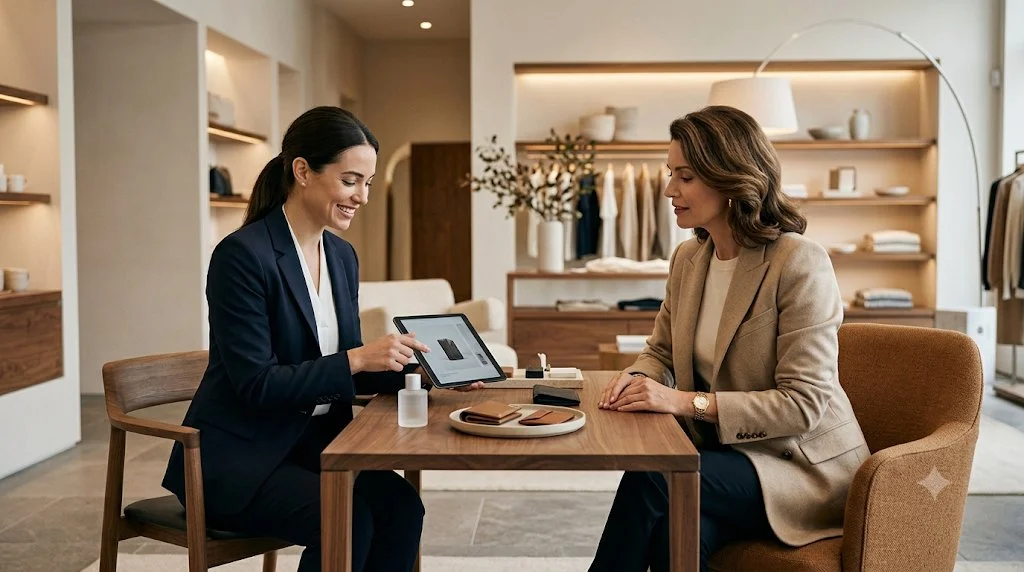

Retail appointment types fall into 6 main categories: consultations, sales-driven sessions like personal shopping, product fittings, VIP and private shopping, group events, and after-sales product care. Each format serves a distinct function in the customer journey and produces measurable differences in conversion, basket size, and retention across store networks.
Any category can be delivered in store, by video, at home, or as a hybrid click-and-meet booking, so the strategic question is which combination of types and delivery modes fits the vertical, service complexity, and customer expectations at each stage.

The 6 retail appointment types below follow the customer journey from discovery to retention. 53% of consumers now expect one-on-one in-store appointments, making the choice of formats a direct lever on revenue and retention.
Best for: beauty, eyewear, petcare, sporting goods, health-focused retailers
Consultation appointments serve customers who need expert guidance before committing to a purchase. The advisor diagnoses, educates, and recommends products based on the customer's specific situation, turning uncertainty into a structured buying decision.
A beauty advisor diagnoses skin type, recommends a personalized routine, and demonstrates products during a scheduled session. Consultation appointments convert at high rates because the customer leaves with a complete regimen rather than a single impulse purchase.
Brands like Clarins and Oh My Cream use this format to help customers identify what they need across cleansers, serums, moisturizers, and treatments, turning a single visit into a multi-product sale.
The experience changes the buying dynamic. A walk-in customer samples one product and leaves. A booked customer receives a full diagnostic, tries a curated selection, and commits to the routine the advisor built for them. Beauty retailers that offer scheduled consultations report significantly higher per-visit revenue than those relying on open-floor interactions alone.
Optician capacity constrains the entire store: when the specialist is in a fitting, every other client waits or leaves. Unlike general retail where any staff member can assist, eyewear appointments require a specific professional with clinical training. The service is non-substitutable, which makes the scheduling process the single biggest lever for throughput.
If a retail vertical includes pet products, sporting goods, or health supplements, nutrition consultations position staff as trusted advisors rather than floor attendants.
Petcare retailers use this format to help customers find the right food, supplements, and care products for their animals. The consultation provides a structured environment where the advisor can check dietary needs, recommend premium alternatives, and explain why one product works better than another.
The same scheduling logic applies to pet care services: grooming sessions, nail trimming, basic veterinary check-ins, and training consultations. These formats run against a constrained resource (a grooming station, a treatment area) which means the KPI is the occupancy rate of the resource itself, alongside customer satisfaction and repeat booking rates. Conversion rates on scheduled pet nutrition consultations reach 80 to 90%, with no-show rates below 5% across the Booxi pet retail network.
Whether the appointment is a 45-minute nutrition consultation, a grooming slot, or a sporting goods wellness session for an athlete, the result is the same: a captive cross-sell window where the customer is in-store, engaged, and receptive to recommendations.
Best for: luxury, fashion, department stores, B2B retail, home and furniture
Sales-driven appointments put a trained associate in front of a customer who has already signaled purchase intent. The associate prepares product selections, reviews preferences, and structures the session around conversion. Three formats dominate this category: personal shopping, styling sessions, and showroom bookings.
Personal shopping generates the highest AOV among retail appointment types because the associate curates products based on stated needs, purchase history, and customer preferences before the session begins. Instead of browsing an open sales floor and trying to choose from hundreds of options, the customer walks into a prepared environment where every item has been selected for them.
The performance gap is measurable. Booxi platform data across 6,000+ retail locations shows scheduled appointments convert at 70% versus 20-30% for walk-ins, a 2.5 to 3x gap that compounds across every store running the format. An available associate who can provide a curated, one-on-one session helps convert browsing intent into a closed sale.
For retailers managing retail appointment scheduling across multiple locations, personal shopping is the format that most directly ties associate time to revenue.
Compared to personal shopping, styling sessions narrow the scope to personalized outfit coordination for a specific occasion, seasonal refresh, or professional makeover. The associate focuses on assembling complete looks rather than browsing across categories, which creates a natural cross-sell process: every outfit includes accessories, footwear, and complementary pieces that the customer might not have considered on their own.
Fashion retailers and department stores offer styling appointments to capture the full purchase potential of a single visit. The format works because the customer delegates the selection to an expert, and new combinations surface products they would have missed browsing alone.
When B2B buyers or wholesale clients need hands-on product evaluation, showroom appointments provide dedicated time with a specialist for in-depth product tours. The format is common in furniture, home decor, and specialty retail where the product requires physical assessment before purchase. Clients who book a showroom session signal serious intent before they walk through the door.
Showroom bookings capture zero-party data before the visit happens: what the buyer wants, when they need it, the budget range, and how many units are in play. For businesses managing multiple locations or trade accounts, this data set turns a single appointment into a qualified pipeline entry.
Best for: specialty retail, fashion, bridal, sporting goods, luxury
Product fitting appointments exist because some categories have a built-in friction point: the customer cannot evaluate the product without trying it. Intimate apparel, footwear, and custom tailoring all share this constraint. Scheduled fittings remove the guesswork, reduce returns, and create a structured interaction where the associate controls the experience from measurement to purchase.
Fitting appointments solve a category-specific pain point: customers who shop alone in intimate apparel often leave without buying because they cannot self-assess fit. A trained associate removes that friction in a single 30-minute session, helping the customer find the right size and style with personal attention that open-floor browsing cannot replicate.
Choose fitting appointments when the product-to-customer match determines satisfaction and return rates. A specialist measures, recommends, and adjusts footwear for specific use cases: running, hiking, formal wear. The process involves checking gait, arch type, and pressure points, which no self-service display can replicate.
The set structure works: a dedicated time slot means the specialist can run through the full fitting without interruption, and the customer leaves with the right pair instead of a best guess from the shelf.
Custom tailoring creates the longest relationship cycle of any appointment type. Brands structure their entire sales process around initial consultation appointments where a specialist discusses fabric, style preferences, and measurements. The first fitting follows 4-5 weeks later, and subsequent alterations may require 2-3 additional visits, making each client relationship a multi-month commitment.
The service is inherently personalized: no 2 orders share the same specifications. Each session builds on the previous one, and the data collected (measurements, fabric preferences, style notes) makes future orders faster and more accurate.
Clients return multiple times across years, not weeks, which is why luxury and bridal retailers treat tailoring as a lifetime value driver rather than a one-off transaction.
Best for: luxury, jewelry, high-end fashion, department stores
VIP appointments exist for one reason: the highest-value clients expect an experience that standard store operations cannot deliver. Private access, pre-briefed associates, and curated selections separate these formats from every other appointment type. The revenue per visit is the highest of any category, and the cost of getting it wrong is measured in lifetime value, not single transactions.
After-hours or limited-access sessions remove every friction point between intent and purchase. The customer shops without crowds, receives full associate attention, and feels the exclusivity that reinforces brand loyalty. Department stores and luxury brands use private access to reward top-tier clients, and the format generates the highest per-visit revenue of any appointment type.
The store becomes a different environment when it's reserved for one client or a small group. Products can be staged in advance, lighting and music adjusted, and the associate can dedicate the full session to a single customer's want list. Making these sessions available by invitation or request signals that the brand values the relationship, not just the transaction.
Unlike standard appointments, VIP sessions start with a pre-briefing: the associate reviews client history, purchase patterns, and preferences before the visit. A curated selection is prepared, the client is greeted by name, and every interaction references prior context.
The best VIP programs manage this handoff systematically so that any associate in the network can deliver the same personalized experience, regardless of location.
The difference between a VIP appointment and a regular personal shopping session is what happens before the client walks in. The associate already knows the client's size, preferred brands, past purchases, and gift-giving patterns. Retailers that invest in building emotional customer loyalty through structured pre-visit preparation see higher retention rates and larger baskets from their top-tier clients.
Pick concierge appointments when a single transaction involves multiple touchpoints: personal shopping, gifting, product care, and delivery coordination. Luxury and jewelry retailers use this format for high-value purchases where the decision cycle spans several visits and the sales process requires continuity across associates and locations.
Each touchpoint is tracked so the client never repeats themselves. The concierge offer covers everything from initial product discovery to post-purchase care, creating a service layer that standard appointment types cannot replicate.
Best for: luxury, fashion, bridal, department stores
Group formats turn a store into a destination rather than a transaction point. Collection launches, workshops, and group shopping sessions generate foot traffic, community engagement, and cross-sell opportunities that one-on-one appointments cannot replicate at scale.
Group registrations for seasonal launches and exclusive previews capture more than attendance numbers. Every registration records preferences, tastes, and budget signals from a retailer's most engaged customers. The operational challenge: without structured check-in and tracking, the event generates conversation but zero CRM data.
Retailers that manage event data alongside their appointment systems can identify which attendees converted within 7 days, which browsed without buying, and which new clients entered the funnel through word-of-mouth.
For luxury retailers tracking their walk-out rate, collection launches create a controlled experience where every interaction is measurable and every exit is a data point.
Group bookings work because social dynamics and dedicated associate attention accelerate buying decisions. Bridal retailers proved this model: when friends and family join the session, the emotional momentum and collective validation make the purchase decision faster and more confident. Department store retailers replicate the format for friends-and-family shopping events and corporate gifting sessions.
Retailers that take the time to structure group bookings properly see higher per-session revenue because every attendee is a potential buyer, not just the person who made the reservation.
Events drive acquisition and community. The final retail appointment types focus on what happens after the sale, when the relationship either deepens or disappears.
Best for: electronics, luxury, jewelry, eyewear, home improvement
After-sales appointments keep the customer relationship active long after the initial purchase. Repair visits, product setup sessions, and scheduled returns each serve a different retention function, but they share one trait: every post-purchase interaction is an opportunity to sell again.
Repair appointments transform cost-center interactions into retention touchpoints. Jewelry cleaning, watch servicing, leather conditioning, eyewear adjustments. Each visit brings the customer back into the store and reactivates the relationship beyond the initial transaction.
The process is straightforward: the client books a service slot, drops off the item, and returns for pickup, but the value is in what happens during those visits.
Luxury and jewelry retailers that manage repair scheduling as a formal appointment type rather than a walk-in queue see higher attachment rates on each visit. Associates can set reminders for annual servicing, recommend complementary products during the pickup, and track service history to flag optimal times for follow-up outreach.
Choose setup appointments when the product has a learning curve that creates returns if left unaddressed. Staff walk the customer through features, check configuration settings, and guide first use during a dedicated session, which eliminates the confusion that leads to "it didn't work for me" returns. Common in electronics, fitness equipment, and smart home retail where the system complexity exceeds what an instruction manual can communicate.
The session also creates a natural upsell moment. An associate helping a customer set up a smart home hub can recommend compatible accessories. A fitness equipment specialist demonstrating a rowing machine can suggest a training app subscription.
Instead of chaotic drop-in return queues, scheduled return sessions give staff predictable time slots and reduce wait times during peak hours. The associate can prepare replacement options in advance, review the customer's purchase history, and convert the return visit into a new sale through one-on-one interaction.
The format works without adding staff headcount: existing associates manage returns within their regular calendar instead of reacting to unpredictable walk-in volume. Making return appointments available online also filters out no-shows and reduces the operational disruption that unscheduled returns cause during busy periods. The option to pre-select a replacement product before arriving shortens the session and increases the exchange rate.
With the 6 retail appointment types mapped, the strategic question becomes practical: which combination should a retail network actually offer?
The right combination of retail appointment types depends on the vertical, customer journey, and staff capacity at each location. No single combination works across every store network, but a structured selection process narrows the options fast.
Appointment-based traffic converts at 70%, walk-ins sit at 20-30%, and the gap is the growth lever every retail network can pull. Booxi closes that gap by powering, measuring, and predicting revenue-generating experiences across multi-location retail networks.
Whether the business operates one flagship or 1,000 stores, the platform unifies appointments, events, and queue management in a single retail-specific tool, with average baskets that grow by 30% on booked interactions and no-show rates that drop well below industry norms.
Talk to an expert to map the appointment mix to the business and turn every in-store interaction into a measurable revenue lever.
The most common retail appointment types include personal shopping, styling sessions, beauty consultations, product fittings, and VIP experiences, with many retailers also offering virtual appointments, event registrations, and after-sales service bookings. The right scheduling mix depends on the customer base and the verticals each store serves.
Customers who book appointments arrive with purchase intent, and associates who prepare in advance can match products to stated needs, removing browsing friction and creating a sales environment where every interaction is purposeful. Across verticals, appointment-based interactions consistently produce higher AOV and conversion than standard store visits, making scheduled sessions one of the most direct levers for in-store revenue.
VIP private shopping, personal shopping with pre-briefed associates, collection launch events, and product care appointments perform best in luxury retail. These formats align with the high-touch, personalized experience that luxury customers expect, and the right combination treats every client interaction as an investment in a multi-year relationship rather than a single transaction.
Retailers that offer both virtual and in-store options capture digital-first customers alongside walk-in traffic through a single scheduling system. Click-and-meet bookings bridge online browsing to store visits, while video consultations extend reach to customers who cannot visit a physical location.
Across Booxi-powered retail networks covering 6,000+ locations, scheduled appointments convert at an average of 70%, compared to a typical walk-in conversion rate of 20-30%. Average basket sizes on booked interactions run roughly 30% higher than walk-ins, and no-show rates on the Booxi platform average under 4%, well below the 10-20% industry baseline for unmanaged appointments. The gap between booked and walk-in performance is the single largest in-store revenue lever multi-location retailers can pull.
More To Explore
Best Retail Queue Management Software In 2026

Appointment Scheduling: What It Is and How It Works?
12 Retail Appointment Scheduling Software Features For Retail Stores